









As an Amazon Associate, Early Bird Wins earns from qualifying purchases. We may earn a commission from links on this page at no extra cost to you.
Disclosure: Early Bird Wins may earn a commission when you buy through links on this page, at no extra cost to you.
Short answer: If you fly with a laptop, the Anker Prime Power Bank (26K, 300W) is the most powerful pack that stays under the 100Wh carry-on limit (it’s rated 99.75Wh). The UGREEN Nexode 25000mAh 145W is a cheaper laptop pick at 90Wh. If you only need to top up a phone, a 10,000mAh pack like the Anker Nano (10K, built-in cable) or the INIU Pocket Rocket P50 is lighter and gives you plenty of room under every airline limit we checked. Whatever you buy: keep it in your carry-on, and check your airline’s rules before you fly. Several carriers have tightened their policies in 2025–2026.
Airline power bank rules in 2026: what you need to know
The baseline: FAA and IATA/ICAO limits
The US FAA’s rules are the reference point most travelers start with:
- Carry-on only. Spare lithium batteries, including power banks and battery cases, must go in carry-on baggage. If your bag gets gate-checked, take the power bank out and keep it with you in the cabin.
- Up to 100Wh: allowed without airline approval.
- 101–160Wh: allowed only with airline approval, limited to two spare batteries per passenger.
- Over 160Wh: not allowed on passenger aircraft.
- Protect the terminals from short circuits, using the original packaging, a pouch, or tape over exposed contacts.
Internationally, an ICAO update took effect on 27 March 2026. As reported, it limits passengers on international flights to two power banks in the cabin and bans recharging them during the flight. The watt-hour thresholds didn’t change.
How to calculate watt-hours (Wh)
Airlines go by watt-hours, not mAh. The formula is:
Wh = mAh × V ÷ 1000
V is the cell’s nominal voltage, usually 3.6V or 3.7V, and not the 5V/20V USB output. Here are two examples from this list:
- UGREEN 25,000mAh × 3.6V ÷ 1000 = 90Wh (matches UGREEN’s spec sheet)
- Anker 26,250mAh × 3.8V ÷ 1000 = 99.75Wh (just under the line)
Always check that the Wh rating is printed on the power bank itself. Gate agents go by what’s on the label, and a pack with a worn or missing label can get turned away.
Airline-specific restrictions on in-flight use
Several airlines have added their own rules after a string of battery fires in the cabin. Here are the ones we were able to verify from news reports. Policies change often, so confirm on your airline’s website before you fly.
- Southwest (from April 20, 2026): one portable charger per passenger, 100Wh or less. It can’t go in an overhead bin, it must stay visible at all times, and you can’t recharge it from the in-seat power outlets.
- Emirates (from October 1, 2025): power banks can’t be used onboard at all. Each passenger may carry one under 100Wh, stowed in the seat pocket or under the seat, not in the overhead bin.
- Lufthansa Group (Lufthansa, SWISS, Austrian, Brussels and others): a two-power-bank limit and no charging power banks in flight.
- Several other international carriers have aligned with the 2026 ICAO rules or restricted onboard use, including Singapore Airlines, Qatar Airways, Cathay Pacific and British Airways.
Practical takeaway: One pack under 100Wh is accepted almost everywhere. Charge it fully before boarding, and plan on charging your phone from it, not charging it from the seat.
Flying out of Singapore Changi? For the airport’s two-bank limit and a Singapore checklist, see our Changi Airport power bank rules for 2026.
Flying in or out of China? Check for the CCC mark
If any leg of your trip is a domestic flight within mainland China, check your power bank before you pack. Since 28 June 2025, the Civil Aviation Administration of China (CAAC) has banned power banks on mainland domestic flights if they lack a valid CCC (China Compulsory Certification) mark, if the marking is unclear or missing, or if the model or batch has been recalled. As of October 2026, that CCC rule has not been extended to international flights, but it applies to domestic connections after you arrive. Non-compliant packs are commonly confiscated or discarded at security.
The CCC mark (often called “3C”) is an oval containing the letters CCC, usually printed or molded on the body or nameplate. Before a China domestic segment, check the label for a clear CCC oval, rated capacity (mAh), and watt-hours (Wh).
Recalls sit under the same rule. In summer 2025, certain Anker and Romoss batches were recalled over battery-cell risks, and China’s market regulator suspended or revoked many CCC certificates. None of this article’s picks match Anker’s widely listed recalled models (for example A1257, A1647, A1652, A1681, A1689), but check older units against the recall list.
Among our picks, only the Anker Nano 10K 30W (model A1259) had a current CCC registry match we could verify. We found no exact matching records for the marketing names of the Anker Prime 26K 300W, UGREEN Nexode 25000 145W, INIU P50 45W, or UGREEN MagFlow 10K Qi2—so check the physical label. US-market units often ship without CCC.
Separate from CCC, several Asian carriers tightened use rules: South Korea (from March 2025) keeps packs with the passenger, not in the overhead bin, and bans charging them in flight; Singapore Airlines (from April 2025) bans using or recharging power banks onboard; Cathay Pacific, aligning with Hong Kong CAD and ICAO’s March 2026 update, limits passengers to two banks and bans onboard use and recharging. Hong Kong and Taiwan do not apply the mainland CCC mark rule.
Practical tip: If you will fly within mainland China, buy a CCC-marked model sold for the China market before you go. A small 10,000mAh pack with a clear CCC oval is cheaper than losing your charger at the checkpoint.
Best power banks for travel in 2026: comparison table
| Power bank | Capacity | Energy (Wh) | Max output | Weight | Best for |
|---|---|---|---|---|---|
| Anker Prime Power Bank (26K, 300W) | 26,250mAh | 99.75Wh | 140W per USB-C, 300W total | 600g | Laptops, power users |
| UGREEN Nexode Power Bank 25000mAh 145W | 25,000mAh | 90Wh | 140W single port, 145W total | 513g | Laptop pick for less money |
| Baseus EnerGeek GR11 20000mAh 145W | 20,000mAh | 72Wh (calculated) | 100W single port, 145W (2 ports) | ~449g (15.84oz) | Built-in retractable cable |
| Anker Nano Power Bank (10K, 30W, built-in USB-C) | 10,000mAh | ~37Wh | 30W single port, 24W total | 215g | Everyday phone top-ups |
| INIU Pocket Rocket P50 | 10,000mAh | ~36–37Wh (calculated) | 45W single USB-C | 160g | Lightest option, budget |
| UGREEN MagFlow Magnetic Power Bank 10000mAh (Qi2 25W) | 10,000mAh | 36Wh | 25W wireless, 30W USB-C | 254g | iPhone users, cable-free |
All six are under 100Wh, so none needs airline approval under FAA rules. Prices change often, so check current price before buying.
The best travel power banks, reviewed
1. Anker Prime Power Bank (26K, 300W): best for laptops

- 300W Total Output Power: Offers 300W max output across two USB-C and one USB-A port, keeping two MacBook Pros running at…
- 140W Max Fast Charging: Delivers up to 140W high-speed output for fast laptop charging when connected to a 5A cable. Pow…
- Anker’s First 250W Dual-Port Input—Recharge to 50% in Just 13 Minutes: With industry-leading 250W dual USB-C input, rech…
This is about as much power as you can carry without asking the airline. Anker rates it at 26,250mAh, which works out to 99.75Wh. It has two USB-C ports at up to 140W each and a USB-A port at up to 22.5W, with 300W total output. That’s enough to charge two laptops and a phone at once. Recharging is just as fast: up to 250W using both USB-C ports, or 140W through one port with a compatible charger and 5A cable. A smart display shows charge status, and the pack also works with Anker’s app.
Pros:
- Highest output on this list; Anker says it charges a MacBook Pro (M4) about 0.8 times
- Very fast two-port recharging, which helps on short layovers
- Just under 100Wh, so no airline approval needed
Cons:
- Heavy at 600g (1.32lb)
- Expensive (check current price)
- At 99.75Wh it’s so close to the limit that some gate agents may look twice. Make sure the label is readable
2. UGREEN Nexode Power Bank 25000mAh 145W: best value for laptops
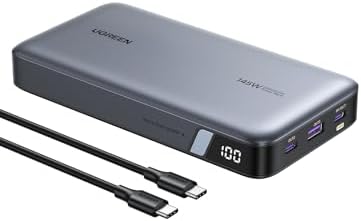
- Ultra-Fast 145W Charging: With PD3.1 and QC3.0, deliver a total of 145W fast charging. A single USB-C1 port provides up …
- Massive 25000mAh Capacity: Ugreen’s power bank features a huge 25000mAh battery, capable of fully recharging laptops up …
- Two-Way Fast Recharge: Recharge the battery pack in just 2 hours using a 65W PD charger (not included). Our bi-direction…
UGREEN’s spec sheet lists 25,000mAh at 3.6V, or 90Wh, which leaves comfortable headroom under the limit. The main USB-C port puts out up to 140W, the second USB-C port 65W, and the USB-A port 22.5W, with 145W maximum across all ports. It recharges at up to 65W through USB-C1, and an LED display shows the remaining charge.
Pros:
- A 140W single port is enough for demanding laptops
- The 90Wh rating is clearly under 100Wh
- Typically priced well below flagship 300W packs (check current price)
Cons:
- 65W input means much slower recharging than the Anker Prime
- 513g and 160 × 80 × 26mm, so it’s bulky in a small bag
- No wireless charging
3. Baseus EnerGeek GR11 20000mAh 145W: best with a built-in cable
The main feature here is a built-in retractable 100W USB-C cable (1.97ft), so you don’t have to pack a separate cable. Baseus rates it at 100W from a single port and 145W across two ports. Output drops to 115W with three devices plugged in and 30W with four. A TFT screen shows charging stats, and the pack recharges at up to 100W. Inside are four 3.6V/5,000mAh cells in series, which works out to about 72Wh.
Pros:
- Retractable cable means one less thing to forget
- 100W from one port charges most laptops
- Compact for its output
Cons:
- Total output drops sharply when all four ports are in use
- A built-in cable is a wear point you can’t replace
- An independent German test (techtest.org) measured 72–80% of rated capacity. That’s normal-ish, but not best in class
4. Anker Nano Power Bank (10K, 30W, built-in USB-C): best everyday carry

- Built-in USB-C cable: Use the built-in USB-C cable to charge your smartphones, tablets and laptops as well as recharge t…
- 30W BI-DIRECTIVE CHARGING: Boost your power bank to 50% in just 45 minutes or charge your iPhone 14 to 50% battery in 30…
- WORRY-FREE POWER WITH 10,000mAh: Experience effortless energy on the go with the built-in USB-C cable, which offers seam…
For phones, earbuds and the occasional tablet, a 10,000mAh pack is the sweet spot. It weighs a fraction of a laptop bank and sits well under every airline limit. Anker’s Nano has a built-in USB-C cable rated at 30W, plus a separate USB-C port (30W) and a USB-A port (22.5W), so it can charge three devices. It weighs 215g and measures 104 × 52.3 × 26mm, with a color display for charge status.
Pros:
- Built-in cable plus two extra ports
- 30W fast-charges current iPhones and Android phones
- About 37Wh, so it’s fine on even the strictest carriers
Cons:
- Total output is capped at 24W when charging several devices
- Not enough power for most laptops
5. INIU Pocket Rocket P50: lightest and best budget pick

- 40% Smaller & Lighter Portable Charger: Powered by the industry’s first TinyCell high-density battery technology, this u…
- 45W Pro Speed Portable Phone Charger: This 45W fast charger boosts an iPhone 17 Pro Max to 76%, a Galaxy S25 Ultra to 84…
- Detachable Cable for Multiple Devices: Unlike a standard portable charger with built in cable that becomes useless if th…
At about 160g and 8.3 × 5.2 × 2.6cm, the P50 is the lightest pick here. Its two USB-C ports each deliver up to 45W, which supports Samsung’s 45W Super Fast Charging (PPS). The third port tops out at 18W. It also includes a detachable USB-C cable that doubles as a lanyard, a digital display, and a three-year warranty.
Pros:
- Very light and pocketable
- 45W single-port output is high for a 10K pack
- Three-year warranty
Cons:
- Per INIU’s own spec sheet, output drops to 15W total whenever two or more ports are in use
- Slow to recharge (20W max input)
6. UGREEN MagFlow Magnetic Power Bank 10000mAh (Qi2 25W): best for iPhone

- Qi2 Certified 25W – Ultra-Fast Wireless Charging : Experience next-gen Qi2 25W, around 30% faster than standard 15W MagS…
- 30W Built-in Cable – Two-Way Fast Charging: The integrated USB-C cable provides up to 30W of wired power for your laptop…
- 17 Powerful Magnets – 1s Snap & Secure Lock: The powerful array of magnets lets you snap your iPhone 18 Pro series (iPho…
If you’d rather not deal with cables on a plane, a magnetic pack snaps onto the back of your phone. Macworld described the MagFlow as the first power bank certified as Qi2.2 compliant. It supports 25W magnetic wireless charging, has a built-in 30W USB-C cable that doubles as a carry strap, and adds a separate 30W USB-C port. It’s rated at 10,000mAh (36Wh) and weighs 254g.
Pros:
- 25W is the top speed of the current Qi2 magnetic standard
- Built-in cable for non-wireless devices
- 36Wh, comfortably under every limit
Cons:
- Full 25W only on iPhone 16 and 17 models running iOS 26 or later. Older iPhones get 15W
- Wireless charging loses more energy than a cable, so you get fewer full charges
- Heavy hanging off a phone (254g)
Buying guide: how to choose a travel power bank
1. Stay under 100Wh
Packs between 100Wh and 160Wh need airline approval, and some carriers, like Southwest and Emirates, cap you at 100Wh anyway. For travel, there’s little reason to go over 100Wh. All six picks above stay under it.
2. Match output to your devices
Phones need about 20–45W. Tablets and small laptops need 45–65W. Larger laptops want 100–140W from a single port. Look at the per-port rating, not just the headline “total output.” Total output is shared across ports, and some packs (like the INIU) drop sharply when you plug in a second device.
3. Think about how many you’ll carry
Under the ICAO rules, you can carry no more than two power banks on international flights. Southwest allows only one. One good pack beats two mediocre ones.
4. Weight vs capacity
A 10,000mAh pack weighs roughly 160–250g. A 20,000–26,000mAh laptop pack weighs 450–600g. If you don’t carry a laptop, the smaller pack is almost always the better travel choice.
5. Recharge speed matters on the road
Hotel stays and layovers are short. A pack that recharges at 100W or more (Anker Prime, Baseus) is ready much sooner than one limited to 20W.
6. Expect fewer charges than the mAh suggests
Voltage conversion and heat waste a lot of energy. Anker says losses of 30–45% are normal. A 10,000mAh bank typically gives about two phone charges, not three.
FAQ
Can I put a power bank in checked luggage?
No. FAA rules require power banks and spare lithium batteries to travel in carry-on bags only. If your carry-on is gate-checked, take the power bank out first.
How many mAh is 100Wh?
At a typical 3.6–3.7V cell voltage, 100Wh is roughly 27,000–27,800mAh. Most packs labeled 20,000–26,800mAh fall under 100Wh, but always check the Wh figure printed on the unit.
Can I use my power bank during the flight?
It depends on the airline. Emirates bans using power banks onboard. Southwest allows use but requires the bank to stay visible. Under the ICAO rules effective March 2026, you can’t recharge a power bank during an international flight. Check your carrier’s current policy before you fly.
Do I need airline approval for a 26,800mAh power bank?
Usually not, if its rating is under 100Wh. A 26,800mAh pack at 3.7V is about 99Wh. Still, some airlines cap passengers at 100Wh or less, so check the label and your carrier’s rules.
Are 10,000mAh power banks allowed on every airline?
Yes. A 10,000mAh pack is about 36–37Wh, well below every limit we found. The restrictions that do apply are about how many you carry and whether you can use them onboard.
Is a magnetic (Qi2) power bank good for travel?
It’s convenient for iPhone users, since there’s no cable to tangle in a cramped seat. But wireless charging is less efficient than a cable, and some airlines ban onboard use entirely. If you need maximum charges per trip, a wired pack is the better choice.
Bottom line
For laptop travelers, the Anker Prime (26K, 300W) is the most capable pack you can carry without airline approval. The UGREEN Nexode 145W costs less and still has a 140W port. For phone-only trips, the Anker Nano 10K and INIU P50 are light enough to forget about, and the UGREEN MagFlow is the best pick for iPhone owners who want to skip the cable. Whichever you choose, keep it under 100Wh, keep it in your carry-on, and check your airline’s latest rules before you leave.



2 thoughts on “Best Power Banks for Travel in 2026”
Comments are closed.