










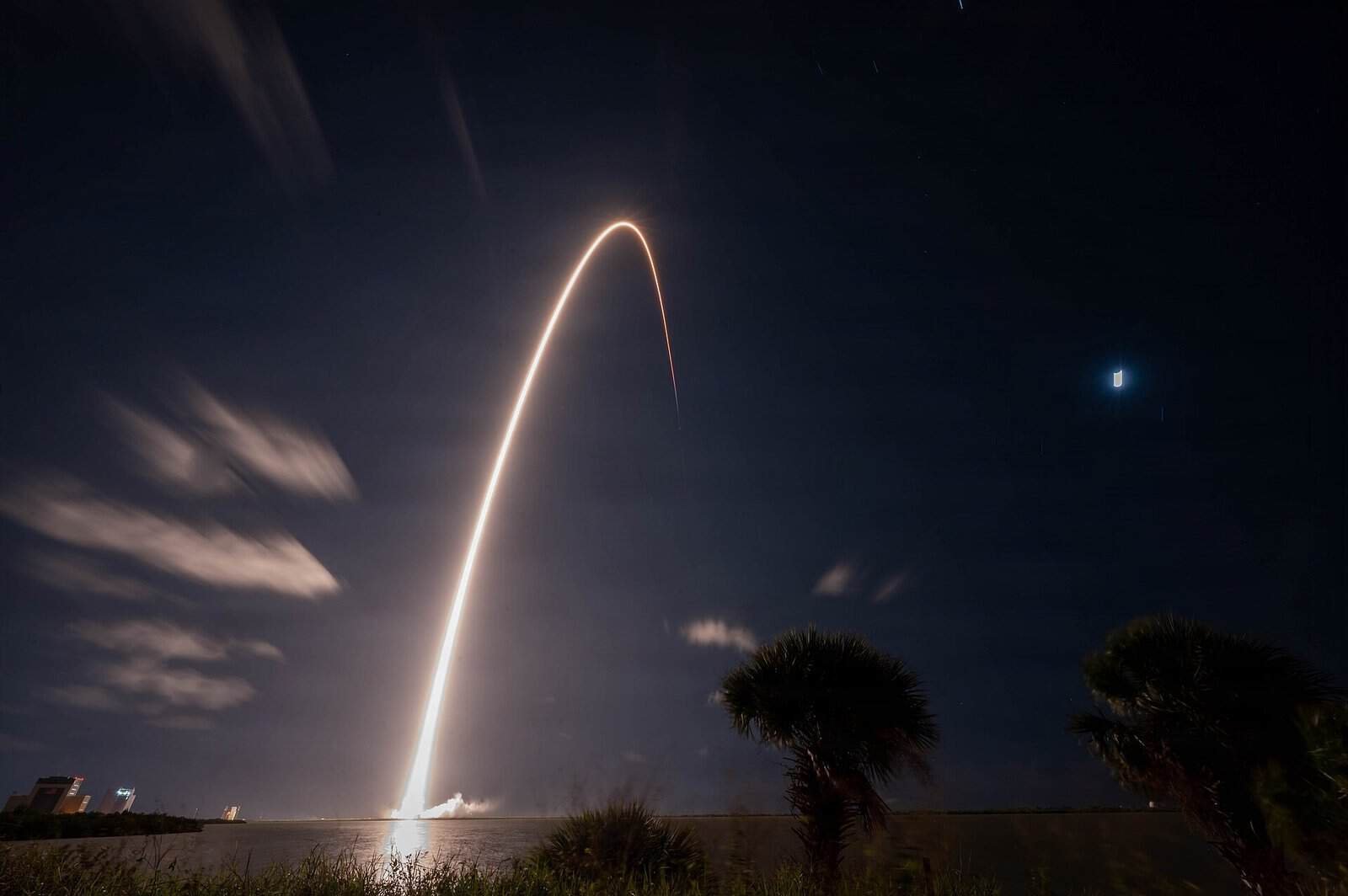
SpaceX just posted the kind of quarter that changes what the company actually is. After the US market close on Tuesday, October 20 (Wednesday morning in Asia), SpaceX (Nasdaq: SPCX) reported third-quarter 2026 revenue of $14.6 billion, up 161% from a year ago, and net income of $4.4 billion, according to its earnings release filed with the SEC. Wall Street was looking for about $12.72 billion in revenue, based on LSEG data cited by Reuters.
The bigger story is where the money came from. For the first time, SpaceX’s Super Intelligence (SI) segment, the renamed AI business that now houses the former xAI, Grok, X and Cursor, brought in more revenue than Starlink. Add a Q1 2027 forecast far above estimates and fresh Tesla merger talk, and there’s a lot to unpack.
The headline numbers
Revenue nearly doubled from the $7.814 billion SpaceX booked in Q2 2026. Operating income swung to $2.791 billion from a $143 million loss last quarter, and diluted EPS was $0.35 versus a loss of $0.36 a year ago.
On an adjusted basis, SpaceX earned 45 cents per share against an IBES estimate of 13 cents, per Reuters. Adjusted EBITDA, a non-GAAP measure, jumped 306% to $8.809 billion from $2.169 billion.
One caveat worth knowing: the net income figure got real help from items below the operating line. The release shows $873 million of interest income, $1.025 billion of other income and a $390 million income-tax benefit. Pre-tax income was $4.014 billion. Operating income is the cleaner read on the businesses.
Key numbers at a glance
| Metric | Q3 2026 | Q3 2025 | Consensus |
|---|---|---|---|
| Revenue | $14.575B | $5.576B | $12.72B (LSEG); $13B (S&P Capital IQ) |
| Income from operations | $2.791B | Loss of $273M | – |
| Net income | $4.404B | Loss of $1.054B | $1.57B (LSEG); $2.12B (S&P Capital IQ) |
| Diluted EPS (GAAP) | $0.35 | -$0.36 | – |
| Adjusted EPS | $0.45 | – | $0.13 (IBES) |
| Adjusted EBITDA | $8.809B | $2.169B | – |
| SI revenue | $7.560B | $813M | $6.47B (S&P Capital IQ) |
| Connectivity revenue | $5.248B | $3.097B | $4.9B (S&P Capital IQ) |
| Space revenue | $1.767B | $1.666B | $1.46B (S&P Capital IQ) |
| Capital expenditures | $19.593B | $6.88B | – |
| Starlink consumer subscribers | 13.6M | 7.2M | 12.19M |
Sources: SpaceX 8-K, Reuters/NBC News, Axios. All three segments beat estimates in only SpaceX’s second report as a public company.
Segment breakdown
Super Intelligence (SI): the new center of gravity
SI revenue hit $7.56 billion, up from $2.561 billion in Q2 and $813 million a year ago. That’s growth of 195% quarter over quarter and 830% year over year. SpaceX credited new cloud services agreements, the Cursor acquisition and Grok adoption. Cursor, which closed on August 14 at an implied equity value of $60 billion, contributed $608 million of revenue through September 30. Advertising revenue from X was $538 million.
Here’s the part I think matters most. According to Reuters, the AI revenue came mostly from renting compute to Anthropic, Google and Reflection AI, making it “a business closer to a cloud provider’s than an AI lab’s.” If you use Anthropic’s tools (I covered one in my Claude Motion explainer), some of that work may be running on SpaceX hardware.
SI swung to operating income of $431 million from a $1.722 billion loss a year ago, and that figure includes $1.2 billion of share-based compensation tied to Cursor. Segment adjusted EBITDA was $4.953 billion. Nameplate compute reached 1.7 GW, up from 1.4 GW in Q2 and 0.6 GW a year ago, with COLOSSUS II under construction. SpaceX also introduced Grok Bot, which it calls an “always-on agentic SI system.” If you’re weighing AI agents, see my Grok Bot vs Muse comparison.
Connectivity (Starlink): the steady cash engine
Connectivity revenue rose to $5.248 billion from $3.097 billion, and segment operating income nearly doubled, up 99% to $2.367 billion. Segment adjusted EBITDA was $3.499 billion. Consumer revenue was $3.121 billion, while enterprise and government revenue grew 91% to $2.127 billion.
Starlink ended the quarter with 13.6 million consumer subscribers, up 1.6 million from 12.0 million in Q2 and up from 7.2 million a year ago. That beat the 12.19 million analysts expected, per Reuters. SpaceX also has “hundreds of thousands” of enterprise subscribers, and Starlink is now on more than 3,800 aircraft.
The trade-off is pricing. Consumer ARPU was $69 a month, up from $66 in Q2 but down from $83 a year ago. Reuters points out ARPU has fallen from $99 in 2023 as Starlink expands abroad with cheaper plans. On October 8, SpaceX also agreed to buy up to 14 MHz of paired 800 MHz low-band spectrum for Starlink Mobile, with closing expected in the first half of 2027, subject to regulatory approval.
Space (launch and Starship): a milestone quarter, thin profits
Space revenue was $1.767 billion versus $1.666 billion a year ago, but the segment posted a $7 million operating loss compared with a $259 million profit in Q3 2025. Segment costs rose $367 million year over year on Starship R&D. Adjusted EBITDA was $357 million. SpaceX flew 35 launches in the quarter (12 for customers), down from 44 total launches a year ago.
The headline was Starship Flight 14: the first orbital Starship flight and the first revenue-generating Starship mission. It deployed 26 Starlink V3 satellites, with roughly 10 times the downlink capacity of a Falcon 9 Starlink launch. SpaceX also launched NASA’s Nancy Grace Roman Space Telescope, signed three more NASA ISS crew missions, 18 National Security Space Launch missions and a Starship lunar payload contract, and announced a new Louisiana spaceport with a first launch targeted for 2029.
Guidance and earnings call highlights
- Q1 2027 revenue guidance of $33 billion to $37 billion, versus an LSEG analyst average of about $22.2 billion. CFO Bret Johnsen cited “increased visibility into our compute contract pipeline over the next six months,” per CNBC.
- Backlog of $63 billion in contracted revenue not yet recognized, with $42 billion expected to convert within the next year. Johnsen said SpaceX is on track for its stated goal of a $100 billion annualized revenue run-rate by year-end, per Stocktwits. Q4 gross margin is expected to be in line with Q2’s 55.3%.
- Q4 capex guidance of $35 billion to $40 billion. Johnsen: “At current pricing, new compute deployments are generating a payback of less than a year,” per Business Insider. Q3 capex was $19.593 billion, of which $16.444 billion went to SI. Nine-month capex totaled $48.1 billion.
- Demand outstrips supply. Elon Musk said the constraint is “more in power and cooling and infrastructure than it is in chips,” and “we could rent out our compute several times over.” The goal is roughly a 50/50 split between internal and rented compute, per Business Insider.
- Buildout pace. Memphis-area data centers are on track to bring 200,000 Nvidia Grace Blackwell systems online “every month for the remainder of this year,” and Musk is targeting volume production of AI chips at Terafab (with Tesla and Intel) in Q3 2028, per CNBC.
- The big Musk number. Musk said annual recurring revenue will be between $500 billion and $1 trillion by the end of 2027. For context, analysts project FY2027 revenue of about $110 billion, per LSEG. Treat that as a Musk claim, not guidance.
Musk summed up his view: “We are in an inflection moment for SpaceX across launch, connectivity and superintelligence,” per Reuters.
The Tesla merger talk
The other big headline: the boards of SpaceX and Tesla each formed special committees of independent directors to review a possible merger, at the request of shareholders, TechCrunch reported. Musk tried to cool expectations: “I think some people out there assume that a SpaceX and Tesla merger is a certainty, and I think that would be overstating it.”
The mechanics aren’t trivial. Tesla would need approval from 50% of all outstanding shares, while Musk holds more than 50% of SpaceX’s voting power. Musk pointed to gains from cooperating on AI software, robotics, SpaceX’s orbital AI data center project Starmind and Terafab, the joint chip project with Tesla. (Tesla’s Roadster is another crossover, which I dug into in what the flying Roadster really means.) Futurum’s Daniel Newman told Reuters a merger “feel[s] imminent,” but Tesla’s December 3 annual meeting has no merger proposal on the agenda, per Stocktwits. Tesla reports its own Q3 results Wednesday after the bell, and TSLA rose about 2% after hours.
Update: for the full picture on the merger talk, including what’s confirmed, how a deal would work and what it could mean for TSLA holders, read our explainer SpaceX and Tesla Merger: What a Combined Musk Company Could Mean.
What it means for SpaceX’s future
Starlink
Starlink is the proven business here: fast subscriber growth, strong operating income and a fast-growing enterprise and government line. The bear point is falling ARPU year over year as cheaper international plans drive volume. My take: that’s a fair trade if subscriber growth keeps outrunning price cuts.
Starship
Flight 14 is the milestone the long-term story depends on. V3 satellites delivering roughly 10 times the downlink capacity per launch could be a big unlock for Starlink economics. But Starship is still a cost center today, pushing the Space segment into a small operating loss. Investors are paying for what Starship might do, not what it earns now.
AI and compute
This is the swing factor. SpaceX is increasingly a compute landlord, and management says new deployments pay back in under a year at current pricing. If that holds, the massive spending looks smart. The bear case is that pricing doesn’t hold. Neoclouds CoreWeave and Nebius were down 28% in October and IREN about 35%, per CNBC, and Gartner estimates more than $3.5 trillion of AI infrastructure spending “could be exposed to impairment” by the end of 2030, per Axios. (For the small-scale version, see my guide to building a personal AI stack.)
Valuation and the stock
SPCX closed Tuesday at about $147.79, down 0.1%, for a market cap around $2 trillion, per CNBC. Shares rose 2.5% in early extended trading, per Reuters, then climbed to roughly 8% in after-hours trading, last around $159.70 when extended trading closed at 8pm ET, per Yahoo Finance data. After-hours moves can reverse, so don’t treat that as settled. For context, SpaceX priced its IPO at $135, opened at $150 on June 12, hit a low of $104.83 on August 3 and has traded as high as about $226.
Risks
- Capex intensity. Visible Alpha estimates capex rising from $69.9 billion in 2026 to $194.3 billion in 2028, per Axios.
- Customer concentration. Reuters says the AI revenue comes mostly from renting compute to a handful of named customers (Anthropic, Google, Reflection AI), so losing or repricing one contract could matter.
- Earnings quality. Net income leaned on interest, other income and a tax benefit.
- Forecast risk. Musk’s $500 billion to $1 trillion ARR target sits far above analyst projections.
- Governance and controversy. Merger uncertainty, Musk’s voting control, and a reported Starshield controversy: the WSJ reported Musk ordered restrictions on Starshield in Ukraine, something he previously attributed to the US government, per CNBC.
- Regulation. The Starlink Mobile spectrum deal still needs regulatory approval.
Bottom line
This was a blowout quarter, and the message is clear: SpaceX is now as much an AI infrastructure company as a rocket and satellite company. Starlink keeps printing money, Starship hit a real milestone, and SI has become the biggest revenue line almost overnight. The bull case is a huge backlog, sub-one-year paybacks and Q1 guidance far above expectations. The bear case is enormous capex, customer concentration and a stock that already prices in a lot. I’d watch two things next: whether the compute contracts convert as promised, and where the Tesla committees land.
This article is for information only and is not financial advice. Do your own research.
One thought on “SpaceX’s Massive Q3 Earnings: AI Is Now Its Biggest Business. Here’s What That Means for the Company’s Future”
Comments are closed.