





As an Amazon Associate, Early Bird Wins earns from qualifying purchases. We may earn a commission from links on this page at no extra cost to you.
Disclosure: Early Bird Wins may earn a commission from qualifying purchases made through links in this article, at no extra cost to you. As an Amazon Associate we earn from qualifying purchases.
Tesla finally showed off its next-generation Roadster on October 15, 2026, and within hours the internet was calling it Tesla’s “flying car.” Elon Musk leaned into it, posting on X that it “turns out the future does have flying cars.” The videos are real. But is this actually a flying car you can buy, a street-legal supercar with a party trick, or a very expensive piece of marketing? Here is what Tesla actually announced, which numbers are confirmed, which are only claims, and what it really means for buyers and investors.
TL;DR
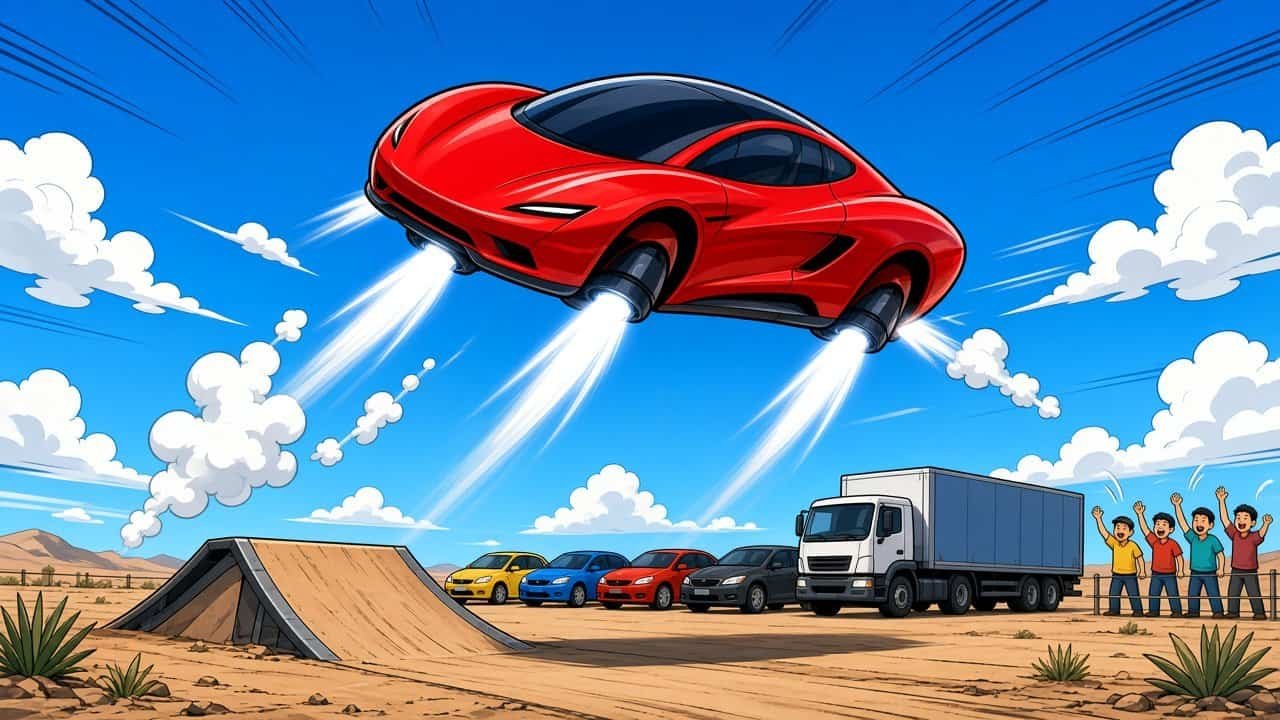
- What happened: On Oct. 15, 2026, Tesla unveiled a redesigned Roadster at a SpaceX test site in McGregor, Texas. A prototype drove upside down on a ramp using fan suction, launched into the air, rolled using cold-gas thrusters and landed on its wheels. It also jumped over a lineup of Teslas, including a Semi.
- Is it a flying car? Only loosely. The demo showed short hops and controlled falls, not sustained flight. No human was driving.
- Three versions: Performance (road-ready, 2 seats), Thrust (rear thrusters, limited release) and Rocket (1 seat, “full flight system,” invite only, not approved for public roads).
- Money: No prices announced. Reservations are $50,000 (Performance) or $250,000 (Thrust). Production is targeted for 2028.
- Regulation: The FAA says the car “does not meet the FAA definition of an aircraft.” NHTSA says it must still meet federal vehicle safety standards.
- Bottom line: It’s a halo car and a tech flex, not a new way to commute. Tesla has missed every Roadster deadline since 2020, so treat 2028 as a target, not a promise.
What Tesla actually announced
The event was livestreamed from SpaceX’s rocket test site in McGregor, near Waco, Texas, starting at 7:55 p.m. local time (8:55 p.m. ET) on Thursday, Oct. 15, according to CNBC. Musk was joined by design chief Franz von Holzhausen and vehicle engineering VP Lars Moravy.
The white two-seat prototype, developed with SpaceX, did three headline stunts, as described by Reuters and Road & Track:
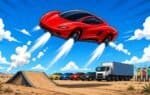
- “The ramp”: The car drove up a curved ramp and held itself nearly upside down using fan-generated suction. On a second run it drove off the end, barrel-rolled with cold-gas thrusters and landed level.
- “The kickflip”: It leapt over four other Tesla models, including a Cybertruck and a Semi truck, rolling in mid-air before landing.
- The launch: A thruster-boosted sprint to 60 mph that Tesla’s timer showed at 0.81 seconds.
Fact-checkers at Snopes rated the footage authentic: it was livestreamed in front of a live audience, and attendees posted their own clips. Snopes also noted the key caveat. The car dropped or launched off a surface and controlled its fall over short distances. It did not demonstrate sustained flight. Fortune reported that no one was behind the wheel, just a mannequin in a SpaceX spacesuit, and that Musk said the car ran autonomously for safety reasons.
Musk was candid about one thing on stage: “This is not necessarily a safety-optimized car,” he said, as reported by CNBC and Fortune.
The three trims
Tesla only shared the configurations after the stream, in a thread on its X account summarized by Electrek, and on its official Roadster page:
- Performance — “road ready,” seats two, active aerodynamics and a “multi-mode suction system.” Available by reservation.
- Thrust — “race ready,” seats two, adds rear-mounted cold-gas thrusters. Limited release.
- Rocket — “air ready,” seats one, adds thrusters around the perimeter for upward and rotational movement. Tesla’s site says: “So yes, it can fly.” Invite only, and “not approved for public road use.”
Real life, baby
— Tesla (@Tesla) October 16, 2026
Watch Tesla’s official flip demo video on X
Specs vs. claims: what’s confirmed and what isn’t
Every performance number below comes from Tesla itself. None has been independently tested, and the demo cars were prototypes. Here is how the claims stack up against what was actually shown and what is still unknown.
| Item | Tesla’s claim | Status |
|---|---|---|
| 0–60 mph (Performance) | Under 1.6 s | Tesla claim (X thread) |
| 0–60 mph (Thrust) | Under 0.9 s | Tesla claim; 0.81 s run shown on Tesla’s timer |
| 0–60 mph (Rocket) | Under 0.59 s | Tesla claim, not demonstrated |
| Top speed | Over 230 mph (Rocket) | Tesla claim; Musk said “much faster” |
| Range | Over 300 miles | Tesla claim (2017 promise was 620 miles) |
| Seats | 2 (Performance, Thrust); 1 (Rocket) | Confirmed by Tesla (2017 promise was 4) |
| Thruster gas | About 600 liters of rechargeable compressed air | Stated by Lars Moravy (via Fortune) |
| Thrust vs. grip | 4–5x the force the tires can handle | Tesla claim (via Electrek) |
| Flight time / distance | Not disclosed | Unknown; only brief hops shown |
| Price | Not announced | Unknown (Tesla quoted $200,000 base back in 2017) |
| Reservation | $50,000 Performance; $250,000 Thrust; Rocket invite only | Confirmed on Tesla’s reservation page |
| Production | 2028 | Target (original target was 2020) |
Two things stand out. First, acceleration got wildly better than the 1.9-second 0–60 Tesla promised in 2017, while range was roughly halved and the back seats disappeared. Second, the stunts that went viral belong to the Thrust and Rocket trims, which are limited or invite only. The version most buyers can actually reserve is the Performance car, and it has no thrusters at all.
How it compares with real flying cars and eVTOLs
The Roadster uses stored compressed gas for short bursts. True flying cars and air taxis use electric rotors for sustained, controlled flight. That’s a big difference, and the companies that have spent years on flight were quick to point it out.
- Alef Aeronautics Model A: On the same day as Tesla’s event, Alef released a video of its electric flying car taking off vertically and flying over an older Tesla Roadster, which it said was its 1,000th logged flight (Interesting Engineering, Gizmodo). “Welcome, Tesla, to the flying car race; we’ve been here alone for eleven years,” CEO Jim Dukhovny said. Alef received an FAA Special Airworthiness Certification in 2023 (not a full type certificate), says the Model A starts at $299,999, and reports more than 3,600 pre-orders. It targets a limited number of deliveries by the end of 2026 for testing “under very controlled conditions.”
- Joby and Archer: These are air taxis, not cars you park in your garage. As of mid-October 2026, neither held an FAA type certificate. Joby says it is in the final stage of FAA certification, and Archer says the FAA has accepted all of its means of compliance, which sets the test plan but isn’t certification. Both have pointed to the UAE for their first passenger flights (FlightBrief).
- XPeng’s Aridge (formerly AeroHT) Land Aircraft Carrier: A six-wheel van that carries and recharges a detachable two-seat eVTOL. It’s priced at about 2 million yuan (roughly $280,000–$300,000) with around 7,000 pre-orders. At IFA Berlin in September 2026, a spokesperson said Chinese regulatory approval and customer deliveries are now expected in 2027 (heise, TechRepublic).
The honest comparison: Alef and XPeng are trying to build vehicles that really fly from A to B. Joby and Archer are building aircraft. Tesla built a hypercar that can hop, flip and stick to a wall. It’s more spectacular on video, but it’s solving a different problem.
Regulation: who is in charge of a car that jumps?
This is where the “flying car” label gets awkward. The FAA told CBS News: “The Tesla vehicle does not meet the FAA definition of an aircraft.” That means the FAA doesn’t plan to certify it as airworthy. It does not mean the car is approved to fly anywhere.
That leaves NHTSA, which relies on automakers to self-certify that cars meet federal safety standards. Its statement to CBS: “While the vehicle may appear to defy the laws of physics, the manufacturer must ensure that it does not defy applicable Federal Motor Vehicle Safety Standards and drivers must obey all local traffic laws. NHTSA will continue to monitor the situation and won’t hesitate to act to protect the driving public.” A senior DOT official told CBS there’s no clear answer yet on oversight.
Tesla’s own site already says the Rocket trim is “not approved for public road use,” and Electrek’s editor expects the thruster features would likely void your warranty. Expect the flying trim to live on private tracks and in influencer videos, at least at first.
Timeline
- Nov. 2017: Next-gen Roadster unveiled; Tesla promised 1.9 s 0–60, 620 miles of range, four seats and 2020 deliveries.
- June 2018: Musk tweets about a “SpaceX option package” with about 10 small rocket thrusters that “maybe” let a Tesla fly.
- 2020–2025: Repeated delays; a promised 2025 demo never happened.
- Oct. 15, 2026: Redesigned Roadster unveiled; reservations reopen.
- Oct. 21, 2026: Tesla reports Q3 results, which analysts say matter far more to the stock.
- 2028: Tesla’s production target (“2028, actually,” per Musk).
What it means for buyers
If you’re thinking of reserving, know the terms. Tesla’s US reservation page asks for $5,000 upfront, described as fully refundable, with the remaining $45,000 due within 10 days or the reservation is canceled. The Thrust trim requires $250,000 in total. There’s no final price for any trim, and Fortune notes Tesla hasn’t said what happens to 2017 deposit holders. A buyer is essentially giving Tesla a large interest-free loan for a car that is at least two years away, whose spec sheet has already changed once.
There’s one more twist. Musk says the Roadster will be the last Tesla designed to be driven by a human, and it won’t get FSD (CNBC). If you love driving, that’s the appeal. If you wanted Tesla’s autonomy tech, look elsewhere in the lineup. For context on the wider EV market, see our look at the EV boom driven by high fuel prices.
What it means for investors (not financial advice)
Tesla shares rose about 5% in premarket trading the morning after the event, per Reuters. Still, almost no one expects the Roadster to move the numbers. Musk himself called it a “small potato situation” in 2023, and Deepwater’s Gene Munster called the event “an engineering flex with no commercial value beyond embarrassing traditional car makers” (Reuters). Dan Ives wrote it “will not move the volume or revenue needle” (via Fortune).
The more interesting signal is strategic. The Roadster is a Tesla–SpaceX co-production, and CNBC and Reuters both reported that it fueled speculation about a possible merger of the two companies. Tesla’s bigger bets remain autonomy and robotics, including Optimus. Read our explainer on humanoid robots and our roundup of robotics tech from CES 2025 for that side of the story. In the near term, Tesla’s Q3 margins and cash flow on Oct. 21 are likely to matter more than any kickflip. Do your own research before investing.
Want to go deeper?
If the Tesla–SpaceX crossover has you curious about how Musk’s companies work, these two well-known books are a good start:

Elon Musk by Walter Isaacson — the bestselling biography with inside access to Tesla and SpaceX.

Liftoff by Eric Berger — the story of SpaceX’s desperate early days, from the company whose thruster tech is now in the Roadster.
The verdict: what it really means
Tesla didn’t launch a flying car you can commute in. It showed a genuinely impressive engineering stunt: atmospheric cold-gas thrusters, a fan system that can hold a car upside down, and sub-one-second launches, all on a prototype. The car most people can reserve won’t fly, the one that “flies” is invite only and not road legal, there’s no price, and the 2028 date comes from a company that has missed every Roadster deadline so far. Enjoy the videos, be skeptical of the label, and if you put down a deposit, read the terms carefully.
FAQ
Can the new Tesla Roadster really fly?
Only briefly. The Rocket prototype used cold-gas thrusters to launch, roll in the air and land. Tesla hasn’t disclosed how long or how far it can stay airborne, and no sustained flight was shown.
How much does the Tesla flying Roadster cost?
Tesla hasn’t announced prices. Reservations are $50,000 for the Performance trim and $250,000 for Thrust. The flying Rocket trim is invite only with no public reservation fee.
When will the new Roadster be available?
Tesla says production starts in 2028. The car was originally promised for 2020.
Is the Tesla Roadster approved by the FAA?
No, and it won’t be in the usual sense. The FAA told CBS News the vehicle does not meet its definition of an aircraft. Tesla says the Rocket trim is not approved for public road use, and NHTSA says the car must meet federal vehicle safety standards.
How does it compare with the Alef Model A?
Alef’s Model A uses electric rotors for vertical takeoff and sustained flight, holds an FAA special airworthiness certificate (not a full type certificate) and starts at $299,999. Tesla’s Roadster uses compressed-gas thrusters for short hops and is primarily a high-performance road and track car.

2 thoughts on “Tesla’s “Flying” Roadster: What It Really Means (and What It Doesn’t)”
Comments are closed.