





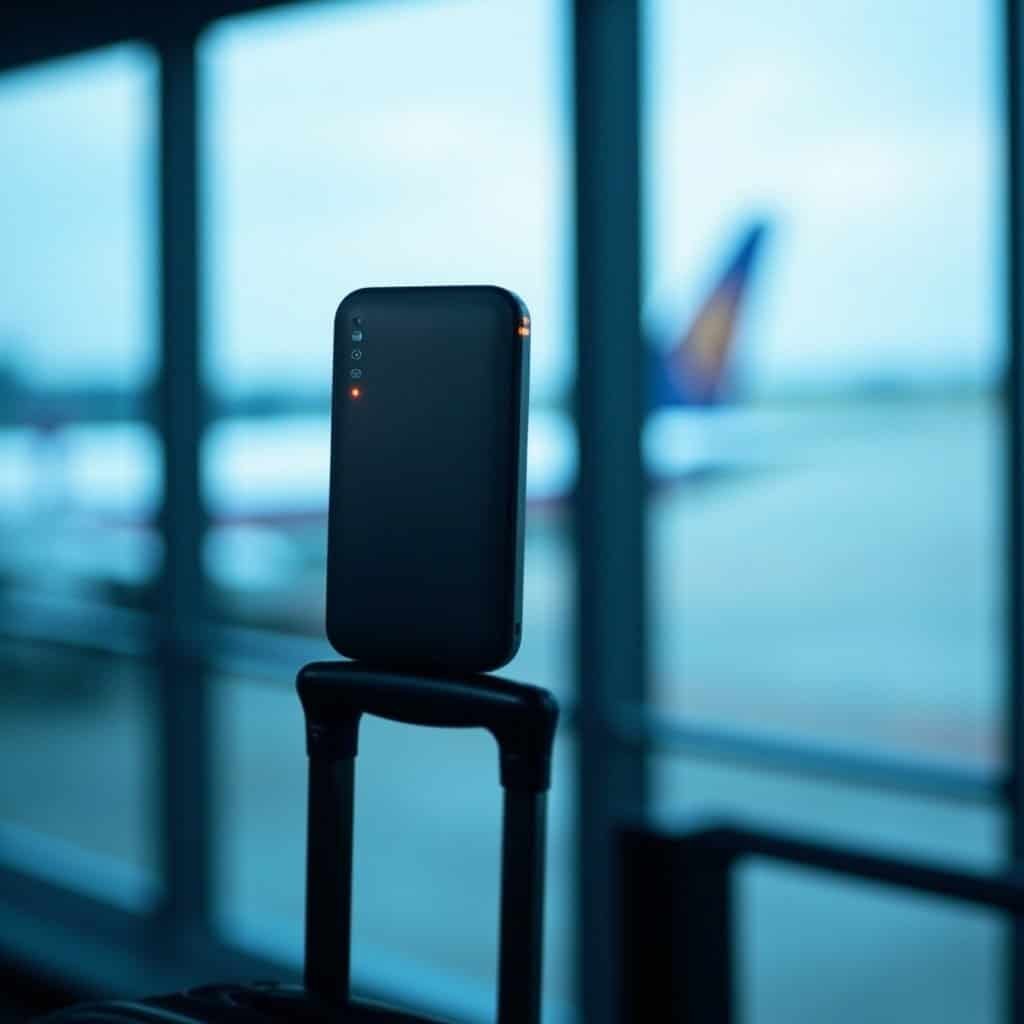
If you’re departing from Singapore Changi Airport after April 15, 2026, you can only carry two power banks in your hand luggage. But that’s just the start of a much bigger story.
Picture this: You’re at Changi Airport, boarding pass in hand, when security stops you at the gate. Your backpack contains three power banks — a 20,000mAh for your phone, a 10,000mAh for your laptop, and a compact one for your earbuds. The officer says “Only two. “The third will be confiscated.”
It sounds like a nightmare. But starting April 15, 2026, it’s official policy.
The Civil Aviation Authority of Singapore (CAAS), acting under new International Civil Aviation Organization (ICAO) standards, announced that all departing passengers from Changi Airport will be limited to a maximum of two power banks in their cabin baggage. The rule applies to every airline — Singapore Airlines, Scoot, AirAsia, and anyone else flying out of SIN.
But here’s what most travellers don’t realise: Singapore’s new two-bank limit is just the tip of the iceberg. Countries around the world are tightening lithium battery rules, and the enforcement varies wildly. If you’ve ever had a power bank confiscated at an airport, you already know the frustration. If you haven’t — you might be next.
Why Are Airports Suddenly So Stricter?
The short answer: lithium batteries catch fire. And aircraft cabins are enclosed metal tubes with limited options for dealing with fires.
Lithium-ion batteries, the rechargeable kind inside every power bank, phone, and laptop can overheat, short-circuit, and ignite without warning. Unlike a standard fire on the ground, you can’t simply open a window. Halon fire suppression systems can smother flames, but they can’t stop thermal runaway, a chain reaction where one overheating cell causes adjacent cells to overheat in a cascade.
The evidence is hard to ignore:
– January 2013: A Japan Airlines Boeing 787 at Boston Logan Airport caught fire shortly after landing, traced to its lithium-ion auxiliary power unit battery. The entire 787 fleet was grounded for months.
– October 2025: A passenger power bank compressed in an overhead bin caught fire mid-flight before takeoff. All 169 passengers and 7 crew evacuated. Nobody died, but the incident made headlines across Asia.
– February 2026: An Alaska Airlines flight diverted after a phone and power bank ignited mid-flight, hospitalising one passenger.
These aren’t isolated incidents. UL Standards & Engagement, which tracks battery incidents in aviation, reported that lithium battery incidents have increased significantly in recent years as power banks became ubiquitous travel accessories. A device that charges your phone is also, potentially, a fire hazard at 35,000 feet.
The ICAO’s response: standardise limits across member states. Singapore’s two-power-bank rule is one of the first concrete implementations of this global shift.
The Basics: What the IATA Rules Actually Say
Before you panic, know the existing rules that still apply everywhere:
The Watt-Hour (Wh) Calculation:
Most people don’t know this, but capacity labels on power banks can be misleading. A “20,000mAh” power bank doesn’t tell you the whole story, you need to calculate the watt-hours.
Wh = (mAh × Voltage) ÷ 1,000
A typical 20,000mAh power bank at 3.7V works out to 74 Wh, well under the key threshold. Most consumer power banks fall below 100 Wh, which means they generally don’t require airline approval.
IATA Guidelines (applies to most international flights):
– Under 100 Wh: Allowed in carry-on baggage without special approval. Must be for personal use.
– 100–160 Wh: Requires airline approval. You can carry a maximum of two of these per person.
– Over 160 Wh: Generally prohibited for personal travellers.
The Critical Rule: Spare lithium batteries, including power banks, must never go in checked luggage. They must be in your carry-on bag, with terminals protected to prevent short-circuits.
Now, here’s where it gets complicated.
China’s 3C Certification: A Different Level of Strict
If you’re flying in or out of mainland China, the rules go further — and many travellers are getting caught out.
Effective June 28, 2025, China’s Civil Aviation Administration (CAAC) banned power banks that don’t carry the China Compulsory Certification (3C) mark from all domestic flights. This isn’t just a capacity limit, it’s a certification requirement.
The 3C mark is China’s mandatory safety certification for a wide range of products, including rechargeable lithium battery packs. Power banks that don’t display the mark, or have unclear markings, are confiscated on the spot. Foreign brands with unclear Chinese certification labels have been caught. Even some domestic Chinese brands have been affected.
The problem? Inconsistent enforcement. Travellers on Reddit’s r/travelchina forum describe it as a “security lottery” as some officers wave you through, others inspect every label and reject anything without obvious 3C marking. A power bank that sailed through Shanghai Pudong might get pulled at Beijing Capital. There’s no reliable way to predict which checkpoint will be strict.
China has also recalled nearly 500,000 Romoss power bank units, including models PAC20-272, PAC20-392, and PLT20A-152 after safety concerns. Carrying a recalled model on a Chinese domestic flight risks immediate confiscation.
The lesson: If you’re travelling in China, your power bank needs both the 100 Wh limit compliance AND the 3C mark. Without it, you’re leaving your device to chance.
Singapore’s New Rules: What Changes From April 15
Singapore’s update brings several layers of compliance:
1. Maximum two power banks per person — regardless of capacity. Even if both are under 100 Wh.
2. Must be in cabin baggage — not checked luggage under any circumstances.
3. No charging or use mid-flight — airlines including Singapore Airlines and Scoot had already restricted in-flight use earlier in 2026.
4. 100–160 Wh devices still require airline approval — the two-bank limit doesn’t change the approval requirement for higher-capacity devices.
5. Over 160 Wh remains prohibited.
CAAS will display advisories at key airport touchpoints and has asked airlines to inform passengers ahead of travel. Screening officers are being trained to enforce the rules. Passengers who arrive with more than two power banks will be asked to dispose of the extras before boarding. No exceptions, no storage.
How to Make Sure Your Power Bank Is Compliant
Before your next flight, do these five things:
1. Check the Watt-Hour Rating
Look for “Wh” printed on the power bank label. If it only shows mAh, calculate it yourself. Anything over 160 Wh, just don’t bring it.
2. Know Your Airline’s Approval Process
For 100–160 Wh devices, contact your airline before you travel. Some require advance notification; others have forms to fill at the gate.
3. Keep Them in Your Carry-On
This is non-negotiable.Checked baggage is pressurised and temperature fluctuations can affect lithium batteries. Power banks in the cargo hold are a fire risk with no one to respond.
4. Protect the Ports
Use the original caps or covers, or tape over USB ports to prevent accidental short-circuits from metal in your bag.
5. For China Travel: Verify the 3C Mark
Look for the 3C logo on the device. If it’s not there and you’re travelling on Chinese domestic flights — leave it at home. International flights out of China typically follow IATA rules, but when in doubt, travel with a clearly labelled, certified device.
The Bottom Line
Power banks aren’t going away. But the days of treating them as harmless accessories are over. Singapore’s two-bank limit is the first major enforcement of ICAO’s new global standard, expect more countries and airports to follow.
The fire risk is real. So is the inconvenience of confiscated devices. But the solution is straightforward: know your device’s capacity, follow the rules, and leave the extras at home.


Have you had a power bank confiscated at an airport? Share your experience in the comments below — it might help another traveller avoid the same fate.